Signs Your Septic Tank Needs Pumping
Quick answer: The most reliable “sign” is time and sludge: EPA says to inspect a household tank every 1 to 3 years and pump about every 3 to 5 years, sooner for a small tank or a large household. Warning signs that you may already be overdue include slow or gurgling drains, sewage odors indoors or in the yard, unusually lush or soggy ground over the tank or drainfield, and wastewater backing up into the house. Those symptoms can also mean a clogged filter or a failing field, so treat them as a reason to inspect and pump—not as a guess you can ignore.
We may earn a commission if you buy through links on this page, at no extra cost to you. Full disclosure and sources are at the bottom of the page.
What are the common warning signs?
Watch for more than one of these, especially if you cannot remember the last pump-out:
- Slow drains or gurgling in toilets, tubs, or a basement floor drain, even after you have cleared the nearest trap.
- Sewage odors in the house, around the tank lids, or over the drainfield. A smell alone can also be a dry trap or a loose lid; see why a house smells like septic.
- Soggy ground, ponding, or unusually bright grass over the tank or drainfield in dry weather.
- Sewage backing up into a tub, shower, or basement fixture.
- A septic alarm that sounds or stays on. That is a high-water warning, not a pump-out schedule by itself. See what to do when a septic alarm goes off.
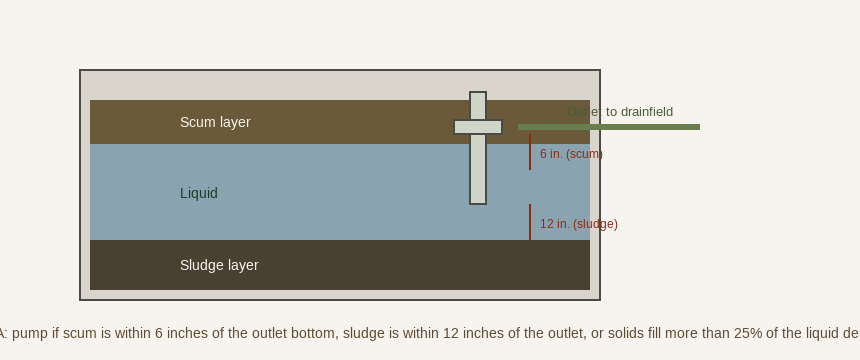
None of these prove the tank is “full” in the everyday sense. A septic tank is supposed to stay mostly full of liquid. Pumping removes the sludge at the bottom and the scum at the top so they do not escape to the drainfield.
How is that different from the 3-to-5-year schedule?
The schedule and the symptoms answer different questions. How often to pump your septic tank is the planning page: EPA’s typical range, the household-size table, and when a garbage disposal shortens the interval. This page is about what you see and smell when you may already be late, or when something else is wrong.
EPA also warns that a tank that “has never needed pumping” is not automatically healthy. Light use can explain it, but so can a leaking tank or a tank that is already sending solids to the drainfield. If you have no records, schedule an inspection and a pump-out rather than waiting for a backup.
A clogged effluent filter can mimic a full tank (slow drains, a high-water alarm) even when the sludge layer is not yet at the pumping point. A failed drainfield can look similar and will not be fixed by pumping alone. That is why a pumper should open the tank, measure layers when they can, and look at the field—not just empty it on a guess.
What should you do if you notice the signs?
- Stop adding a lot of water if drains are already slow or sewage is surfacing. No laundry marathon, no long showers.
- Find the lids if you have not already. How to find your septic tank lid.
- Call a licensed pumper for an inspection and, if needed, a pump-out of both compartments. Ask them to note sludge and scum levels and the condition of the baffles and filter.
- Do not pour additives in as a substitute. EPA does not recommend septic tank additives for household systems. See septic tank additives: do they work?.
If the lids are buried every time, a riser makes the next inspection and pump-out faster. That is a convenience and access choice, not a treatment.
Worked example
A four-person household has a 1,000-gallon tank and no pump-out record for six years. Toilets have started to gurgle, and a patch of grass over the drainfield stays soft after other parts of the yard have dried. The schedule table on the pumping page would already have pointed this family toward a two-to-three-year interval, so six years is late. The gurgling and wet grass are extra reasons to call a pumper now, not to try an additive or wait for a backup in the house. After the tank is pumped, the pumper can say whether the field still looks like a watering issue or a longer-term problem.
When should you call a pro?
Call a licensed pumper promptly if sewage is backing up, pooling in the yard, or you have a persistent sewage odor outdoors. Call the same day if an alarm stays on or drains fail. Never enter a septic tank. This page is not legal, code, or engineering advice. If you cannot find the lids, or the tank is under a driveway, have the pumper locate it rather than digging at random.
Frequently asked questions
How do you know when a septic tank needs to be pumped out?
Use EPA’s inspect-every-1-to-3-years and pump-every-3-to-5-years starting point, adjusted for tank size and household size. Add an inspection sooner if you have slow drains, odors, soggy ground, or no records.
Can a septic tank be full even if toilets still flush?
Yes. A tank is designed to stay mostly full of liquid. The risk is a thick sludge or scum layer reaching the outlet, not a tank that looks empty. Toilets can keep flushing while solids move toward the field.
Do lush grass or gurgling pipes always mean it is time to pump?
They are warning signs, not a complete diagnosis. They can also point to a clogged filter, a broken baffle, or a failing drainfield. Have the tank opened and inspected.
What if you just pumped and the signs are already back?
Call the pumper back. Recurring symptoms right after a pump-out can mean a remaining clog, a failed baffle, a leaking tank, or a field that cannot take water. Pumping again without an inspection is not the next step.
Related guides
How often to pump your septic tank · How much does it cost to pump a septic tank · What to do when a septic alarm goes off · Why a house smells like septic · A first-timer’s septic maintenance guide
Sources and notes
Affiliate disclosure: Some links on this page will be affiliate links. If you buy through them, we may earn a commission at no extra cost to you. We have not tested products, and this page has no product table.
Last checked: November 27, 2026 (America/Chicago).
- U.S. EPA, How to Care for Your Septic System: inspect at least every three years; typical pump-out every 3 to 5 years; warning signs include backups, odors, and saturated soil.
- U.S. EPA, Frequent Questions on Septic Systems: inspect every 1 to 3 years; pump every 3 to 5 years; a tank that has never been pumped can still be a problem.
- U.S. EPA, Do your Part—Be SepticSmart!: pumping is how solids are removed; watch for wet spots and odors.