How to Find Your Septic Tank Lid
Quick answer: To find a septic tank, start with records and the sewer pipe leaving the house, then look in the yard along that line—often about 10 to 20 feet from the foundation. Many tanks have two lids, one at each end, and they may be at grade or buried under a foot or more of soil. If you still cannot find them, call a septic pumper or your local health department rather than digging at random.
We may earn a commission if you buy through links on this page, at no extra cost to you. Full disclosure and sources are at the bottom of the page.
Where should you look?
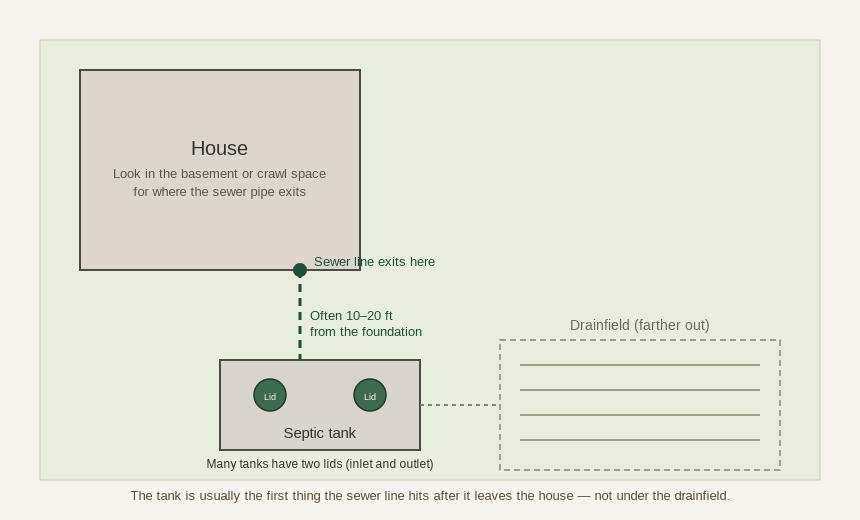
The tank is usually the first thing the building sewer hits after it leaves the house. The drainfield is farther out. Do not start digging in the drainfield to find the lid.
How do you find the lid, step by step?
1. Check the paperwork first. The U.S. EPA recommends looking at property records, the deed, the building permit, or design plans. Your local health or permitting office may have an as-built sketch. House-sale files and the last pumper’s invoice sometimes show the spot too.
2. Follow the pipe out of the house. In a basement or crawl space, find where the main sewer line goes through the wall. UGA Extension and several health departments describe the tank as typically about 10 to 20 feet outside, often in a straight line from that exit. EPA’s septic FAQ puts a common distance at about 10 feet and notes that you might already see a black or green access riser at the surface.
3. Call 811 before you probe. UGA Extension is clear on this: have utilities marked before you drive a rod into the soil. 811 will not mark lines you own, such as irrigation or landscape lighting, so still probe gently.
4. Probe along the sewer line, not at random. After utilities are marked, a thin metal probe can help you feel the top of the pipe, then the tank. Anne Arundel County (Maryland) health guidance says to search carefully along the main sewer and warns you not to damage the pipe. UGA Extension suggests starting several feet from the house, working outward, and trying after a rain, when the soil is softer. Their bulletin says the top of the tank is often 1 to 4 feet down, and a typical tank might be about 5 by 8 feet—sizes vary, so treat that as a starting point, not a rule.
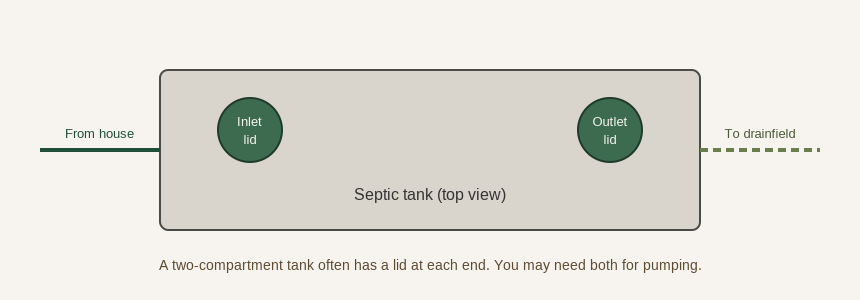
5. Look for two lids, then mark them. Two-compartment tanks commonly have a lid at each end. Newer systems may already have a riser or marker pipe at grade. Once you find the lids, sketch the location relative to the house so you do not lose it again.
Yard clues can help, but they are not reliable by themselves. UGA Extension notes that grass over the tank can look drier, and grass over the drainfield greener, in dry weather—and that this is not always the case.
Worked example
A one-story house has bathrooms along the back wall. In the crawl space, the 4-inch sewer line leaves through the rear foundation, a little right of center. There is no riser visible in the yard.
- Call 811 and wait for marks.
- From that exit point, look 10 to 20 feet straight out into the backyard (the range cited by UGA Extension and Anne Arundel County; EPA mentions about 10 feet as a common distance).
- Probe gently along that line, starting several feet off the foundation so you are less likely to hit the sewer pipe itself.
- When the probe meets a broad, solid surface instead of soil or a narrow pipe, work outward to find both ends of the tank and the lids on top.
- Mark the lids, take a photo, and draw a simple map like the one above. If a lid is cracked, go to Septic tank lids and covers. If the lids are buried and you want them at grade, measure next: How to measure for a septic tank riser kit.
What if the lid is buried and you want easier access?
A riser brings a screw-down lid up to ground level so you are not digging at every pump-out. See Do I need a septic riser? and, when you are ready to compare kits, Risers for septic tanks: the best kits and how to pick one.
Once the lids are findable, use them: how often to pump your septic tank depends on being able to open the tank, and the effluent filter usually sits under the outlet lid.
When should you call a pro?
- You cannot find the tank after checking records and probing carefully.
- You hit something you cannot identify, or you are worried about hitting the sewer line or a utility.
- The lid is broken, missing, or the ground over the tank has caved or smells like sewage. Keep people and pets away and call a licensed pumper or installer.
- You would rather not dig. EPA says your local permitting authority can point you to local septic professionals who can walk the property and locate the system.
Never enter a septic tank. Tanks can contain dangerous gases. This page is practical locating help, not legal, code, or engineering advice.
Frequently asked questions
How far from the house is a septic tank?
UGA Extension and Anne Arundel County often put it about 10 to 20 feet outside, in line with the building sewer. EPA mentions about 10 feet as a common distance. Distances vary, so records and the pipe itself beat a single number.
Do septic tanks have one lid or two?
Many two-compartment tanks have a lid at each end. You may need both for a proper pump-out. One lid is usually the inlet (closer to the house) and one is the outlet (toward the drainfield).
Should you dig before calling 811?
No. Call 811 and wait for marks before you probe or dig. 811 will not mark lines you own, such as irrigation, so still work carefully.
What if the lids are under a foot of soil?
That is common. Probe after utilities are marked, then decide whether a riser is worth it so you are not digging at every visit.
Related guides
A first-timer’s septic maintenance guide · Do I need a septic riser? · How to measure for a septic tank riser kit · How often to pump your septic tank · Septic tank lids and covers
Sources and notes
Affiliate disclosure: Some links on this page will be affiliate links. If you buy through them, we may earn a commission at no extra cost to you. We have not tested these products. There is no product table on this page; kit and lid picks live on the buying guides linked above.
Last checked: November 27, 2026 (America/Chicago).
- U.S. EPA, Frequent Questions on Septic Systems: check property records; follow the plumbing outlet; you might find a black or green access riser; the tank is often about 10 feet from the building; local permitting staff can refer you to professionals.
- University of Georgia Extension, A Beginner’s Guide to Septic Systems (Bulletin 1421, revised October 18, 2024): tank often 10 to 20 feet outside, in front of the building sewer; call 811 before probing; tank top often 1 to 4 feet down; sketch the location once found.
- Anne Arundel County Department of Health, Guidelines for Locating Your Septic System: typically 10 to 20 feet from the foundation; probe carefully along the sewer line; two-compartment tanks have a lid for each compartment.
- University of Arizona Cooperative Extension and Clemson HGIC fact sheets: start from the drain pipe or plumbing vent and probe 10 to 15 feet (Arizona) or at least 5 feet and possibly farther (Clemson) from the structure.