Can You Drive Over a Septic Tank or Drain Field?
Quick answer: You should not drive or park on a septic tank or a drainfield, and you should not put a patio, shed, or pool over either one. EPA says to keep vehicles and buildings off the drainfield because weight can crush pipes and compact the soil that treats wastewater. Driving over the tank can crack a lid, shift a riser, or damage the tank top. Mowing with a regular lawn mower is usually fine.
We may earn a commission if you buy through links on this page, at no extra cost to you. Full disclosure and sources are at the bottom of the page.
Can you drive over the tank itself?
Treat the tank and its lids as a no-vehicle zone, even if the lids are buried. A passenger car or a delivery truck can crack a plastic cover, collapse a riser, or stress a concrete top that was never designed as a driveway. “The tank is underground, so it should be fine” is a common mistake.
If a lid is already at grade in a parking strip, do not assume a replacement cover is traffic-rated unless the manufacturer says so. Ordinary residential lids and riser kits on our lids and riser pages are for yard access, not for a driveway. A tank under a drive usually needs a professional, traffic-rated design.
If a vehicle already crossed the tank and you now have a cracked or shifted cover, make the opening safe and see how to replace a septic tank lid. Do not leave a hole open.
Can you drive or park on the drainfield?
No. The drainfield (also called a leach field) is a shallow network of pipes in soil. EPA’s homeowner guidance is direct: do not drive, park, or build over the drainfield. Weight can break laterals and compact the soil so it can no longer accept effluent. That kind of damage is far more expensive than routing a driveway around the field.
The same no-build rule covers sheds, decks, above-ground pools, and paved patios on top of the field. Shallow-rooted grass is the usual cover. Trees and shrubs with aggressive roots belong away from the field.
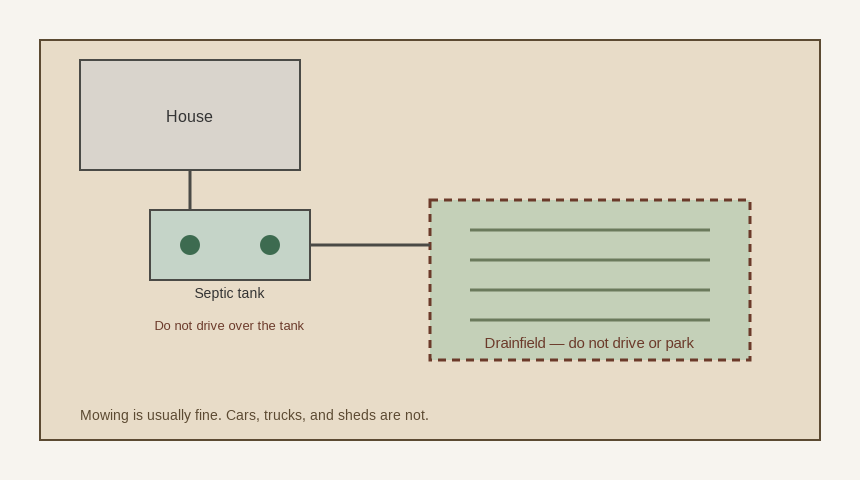
If you have not marked the tank and field yet, use how to find your septic tank lid and any as-built drawing or permit you can get from the county. Mark the edges so guests and delivery drivers are not guessing.
What about mowing, livestock, and one-time access?
A walk-behind or ordinary riding mower on dry grass is the usual exception, because the load is light and brief. That is not a license for a heavy tractor, an RV, or a stack of pallets “just for the weekend.”
Livestock or a farm vehicle can compact a field the same way a truck can. If the system was not designed for that use, keep animals off the field area.
If a vehicle already crossed the field, watch for soggy spots, sewage odors, or lush stripes over the laterals, and call a licensed inspector if those warning signs appear. Pumping the tank will not un-crush a pipe.
When should you call a pro?
Call a licensed pumper or installer if a lid is cracked or missing, if the ground over the tank has slumped, or if the drainfield shows wet spots or odors after vehicles crossed it. Call before you pour a driveway or set a shed if you are not sure where the system is. Never enter a septic tank. This page is not legal, code, or engineering advice. Local rules may also limit what you can place over a system.
Frequently asked questions
Can you drive over a buried septic tank?
You should not. Burial does not make the lid or the tank top traffic-rated. Keep vehicles off the tank and the field.
Can you drive over a septic tank drain field or leach field?
No. EPA says not to drive, park, or build on the drainfield. The soil and pipes need to stay uncompacted and unbroken.
Can you drive over a septic tank riser?
Not with a car or truck. A riser and its lid are made for access in a yard, unless a manufacturer and a designer have specified a traffic-rated assembly.
What if a concrete tank is under an existing driveway?
Do not add weight or assume it is safe because it has “always been there.” Have a licensed professional inspect it before you change the driveway or start parking heavier vehicles there.
Related guides
How to find your septic tank lid · How to replace a septic tank lid · Septic tank lids and covers · A first-timer’s septic maintenance guide · Signs your septic tank needs pumping
Sources and notes
Affiliate disclosure: Some links on this page will be affiliate links. If you buy through them, we may earn a commission at no extra cost to you. We have not tested lids or tanks under vehicle loads.
Last checked: November 27, 2026 (America/Chicago).
- U.S. EPA, How to Care for Your Septic System: do not drive or park vehicles or build structures on the drainfield; plant only grass over the field; keep lids secure.
- U.S. EPA, Frequent Questions on Septic Systems.
- U.S. EPA, Do your Part—Be SepticSmart!: protect the drainfield from vehicles and construction.