Septic Effluent Pump: When and How to Replace One
Quick answer: A septic effluent pump sits in a pump chamber (sometimes called a dose tank) and moves already-settled liquid out to a drainfield, mound, or STEP line. It is not the truck that pumps the tank. If the pump has failed, match the nameplate on the old pump—voltage, discharge size, horsepower, and the head (lift) your system needs—before you order a replacement. We have not installed these pumps. Electrical work and anything that requires reaching into the chamber belong to licensed pros. Never enter a pump chamber.
We may earn a commission if you buy through links on this page, at no extra cost to you. Full disclosure and sources are at the bottom of the page.
How is an effluent pump different from pumping the tank?
Two different jobs share the word “pump,” and they get mixed up in search:
- Pumping the tank is a service visit. A pumper removes sludge and scum on a schedule. See how often to pump and pumping cost.
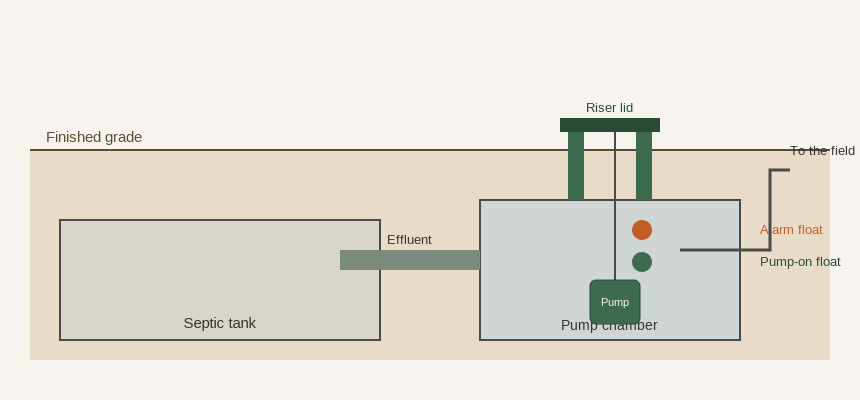
- An effluent pump is a piece of equipment in a pump chamber after the septic tank. It turns on when a float (or a control panel) says the dose tank is high enough, and it sends liquid to the field.
A sewage ejector is built to move raw sewage and larger solids, often from a basement basin. A grinder pump cuts solids into a slurry. An effluent pump is rated for pretreated liquid with smaller solids, often around 1/2 to 3/4 inch, depending on the model. Do not buy a cheap basement sump pump as a stand-in, and do not assume a sewage ejector is the right replacement just because it is on sale.
Gravity septic systems often have no effluent pump at all. If you have no pump tank, no control panel, and no high-water alarm, this page may not apply.
How do you know the pump needs replacement?
Common clues, none of which you should diagnose by climbing in:
- The septic alarm is on and stays on after you cut water use and reset a tripped breaker once.
- You can hear the pump running but the water level in the chamber does not drop, or you hear a pump that short-cycles or does not start.
- A service technician has already isolated a failed motor, a destroyed impeller, or a cord fault and told you the pump is finished.
A stuck float, a tripped breaker, a clogged effluent filter upstream, or a saturated drainfield can look like a dead pump. If you have not ruled those out, replacing the pump is a guess. EPA says systems with electrical floats or pumps should generally be inspected once a year.
What specs have to match?
Read the nameplate on the existing pump, or the last invoice, and match these before you click buy:
- Voltage and phase, usually 115 V or 230 V, single phase in a house.
- Discharge size, often 1-1/2 inch NPT on residential effluent pumps. The discharge has to connect to the pipe that is already there.
- Performance at your head, not just horsepower. A 1/2 HP pump can have very different flow at 10 feet versus 30 feet of lift. If you cannot read a pump curve, have a designer or installer size it.
- Solids handling in the effluent range the old pump was built for.
- How it is switched: a piggyback or integral float versus a bare pump run by a panel and a float tree. Many septic panels want a non-automatic pump plus external floats. An “automatic” pump with a built-in switch can be the wrong choice for a panel system.
- Cord length. A 10-foot cord will not reach a tall riser and a distant box.
If you cannot read the nameplate and have no paperwork, then do not guess from a photo on a product page. Have a technician identify the pump.
What did we find on Amazon on this pass?
We looked for clean, in-stock featured offers of residential effluent pumps on November 27, 2026 (America/Chicago). We did not get a table we can stand behind as good / better / best, so this page does not invent one.
- The Liberty FL51A mid-range head effluent pump (1/2 HP, 115 V, 1-1/2 inch discharge, 1/2-inch solids, automatic switch, 10-foot cord; listing B007NO1N84) had no featured Amazon offer on this pass. We do not price it as a pick.
- The Little Giant 9EC-CIA-SFS automatic sump/effluent pump, model 509804 (4/10 HP, 115 V, 3/4-inch solids, 30-foot cord, integral snap-action switch; listing B0DNNS98CD) was listed at about $612 as of Nov 2026 and was temporarily out of stock. The listing describes it as suitable for effluent systems. The integral switch and “sump/effluent” labeling mean it is a match only if your system can use that kind of automatic pump.
- The Zoeller BN153 / 153-0005 Dose Mate (1/2 HP, 115 V, 1-1/2 inch NPT, 3/4-inch solids, 20-foot piggyback float) is a commonly specified residential effluent pump, listed as B079M6LLP4. We could not confirm a featured Amazon price or stock on this pass, so it is a model to compare against your nameplate, not a priced recommendation.
Check the current price and stock on the day you buy, and confirm the title, voltage, and switch type still match. If a listing is out of stock or has no featured offer, wait or buy from a septic supplier with the same model number. A high-water alarm is a separate part; replacing the pump does not replace a failed alarm.
When should you call a pro?
Call a licensed septic technician or electrician if the alarm stays on, if you need to pull a pump, if the panel or floats are in question, or if you cannot match a nameplate. Pump chambers contain the same dangerous gases as a septic tank. Never enter a pump chamber. This page is not electrical, code, or engineering advice. Local rules may require a licensed installer and a specified pump curve for mounds and pressure systems.
Frequently asked questions
What is a septic effluent pump?
It is a pump in a dose or pump tank that moves pretreated liquid to the drainfield or a pressurized line. It is not the service that empties sludge from the septic tank.
Can you replace a septic pump yourself?
Only if you are competent with the electrical disconnect, the piping, and working from above a chamber, and local rules allow it. Many homeowners should hire a licensed technician. Never climb into the chamber.
How much does a septic tank pump replacement cost?
The pump itself is often several hundred dollars when it is in stock; labor, floats, and a panel are extra and local. We could not post a clean in-stock Amazon featured price for a recommended pump on November 27, 2026.
Will a new pump fix a failing drainfield?
No. A new pump cannot repair compacted or saturated soil. If the field cannot accept water, replacing the pump treats a symptom at best.
Related guides
What to do when a septic alarm goes off · Septic alarms · Effluent filter cleaning and replacement · How often to pump your septic tank · A first-timer’s septic maintenance guide
Sources and notes
Affiliate disclosure: Some links on this page will be affiliate links. If you buy through them, we may earn a commission at no extra cost to you. We have not installed or laboratory-tested these pumps. Listings without a confirmed featured offer or that were out of stock are not priced picks.
Checked on November 27, 2026 (America/Chicago). Last checked: November 27, 2026.
- U.S. EPA, How to Care for Your Septic System: inspect systems with electrical floats or pumps at least annually; never enter a tank.
- Liberty FL51A, no featured Amazon offer on this pass: Amazon B007NO1N84.
- Little Giant 9EC-CIA-SFS (509804), about $612, temporarily out of stock: Amazon B0DNNS98CD.
- Zoeller BN153 (153-0005), featured Amazon price not confirmed on this pass: Amazon B079M6LLP4. Manufacturer identification: Zoeller model 153-0005.