How to Install a Septic Tank Riser
Quick answer: A septic tank riser is installed over the tank opening so a fastening lid sits at ground level. Measure the opening size and the height to grade first, buy a kit that matches both, then follow that kit’s instructions to set, seal, and backfill the stack. We have not installed these kits. The steps below are a homeowner overview, not a substitute for the manufacturer’s sheet or for a licensed installer when the opening is damaged, under a driveway, or larger than the kit allows.
We may earn a commission if you buy through links on this page, at no extra cost to you. Full disclosure and sources are at the bottom of the page.
What has to be true before you install?
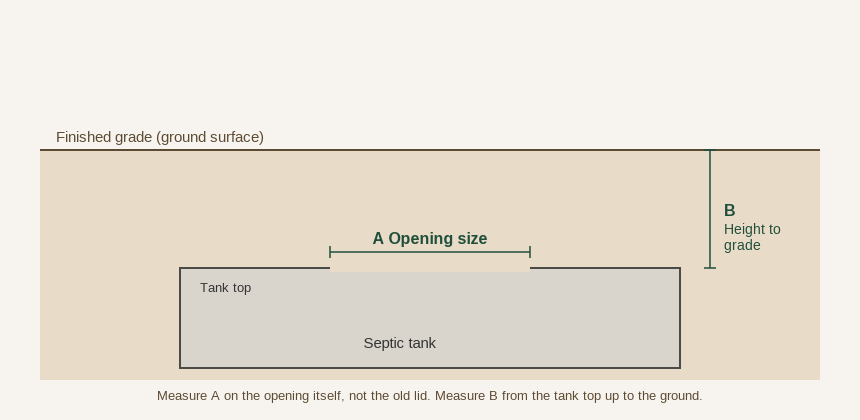
Do not open a kit until you have the two measurements from How to measure for a septic tank riser kit:
- A: the tank opening itself, not the old lid.
- B: the height from the top of the tank to finished grade.
If you have not found the lid yet, start with how to find your septic tank lid. If you are still deciding whether you need a riser at all, see Do I need a septic riser?.
Compatibility rules, in plain if/then language:
- If you have not measured A and B, then do not order a kit.
- If a sound, fastening lid is already at grade, then you may only need a replacement lid.
- If the concrete around the opening is cracked, leaking, or under a driveway, then skip a DIY kit and call a pro.
- If the kit’s adapter does not list your opening, then do not force it.
When the numbers are in hand, pick a kit on Risers for septic tanks. For a mid-20-inch opening and about 18 inches of bury, a complete Aero-Stream AS-R19 kit was about $404 as of Nov 2026 as of November 27, 2026 (America/Chicago), check current price. Shallower tanks can use a shorter kit.
What are the basic install steps?
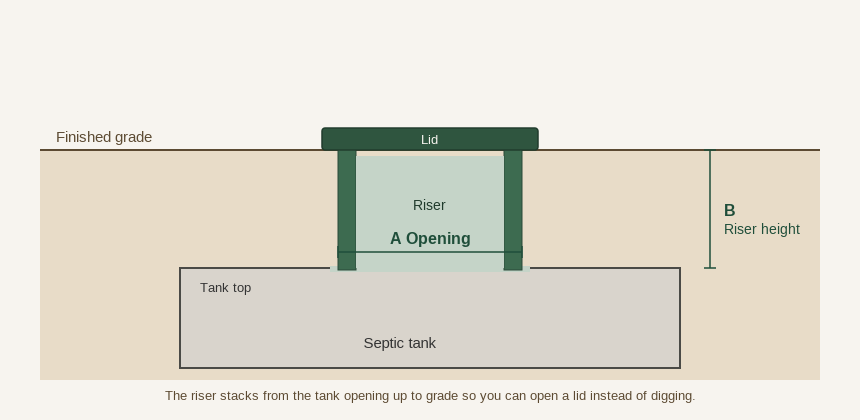
Follow the sheet that comes with your kit. Brands differ on adapters, seals, and whether sections twist, stack, or need screws. This is the usual order, done entirely from above grade:
- Call 811 before you dig, and keep children and pets away from the opening.
- Expose the tank opening and clean the surface where the adapter or first section will sit. Do not chip blindly at concrete.
- Dry-fit the adapter and riser sections so the finished lid will sit at or just above grade, not in a hole and not as a trip hazard.
- Set and seal the adapter and each joint with the gasket, sealant, or fasteners the manufacturer specifies. A leaky joint can let surface water into the tank and wastewater out.
- Install the lid so it fastens. A loose cover is a fall hazard. If the kit includes a safety screen or inner lid, install that too.
- Backfill carefully around the stack so soil does not push the riser off the opening, then mark the lid so you can find it again.
Never enter a septic tank. Do not leave an open hole unattended. If a seal will not seat, or the adapter rocks on a broken tank top, stop and call a licensed installer.
How do you keep the joint sealed and the lid safe?
The two failures that matter after a rushed install are a leaky base and a lid that does not fasten. Use only the seal or gasket the kit calls for—do not substitute random foam or leftover roof cement unless the manufacturer says so. Recheck that the lid screws, cams, or locks actually catch before you backfill.
Local rules may require a licensed installer or a permit to add a riser. This page is not code advice. Check with your health department if you are unsure.
Worked example
The measurement page’s example is a 22-inch opening and 18 inches from tank top to grade. That job needs a kit whose adapter covers a mid-20-inch opening and whose stack is at least 18 inches tall, such as the 19-inch Aero-Stream AS-R19 complete kit, about $404 as of Nov 2026, check current price. After the kit arrives, the homeowner still has to dry-fit, seal, and fasten the lid to that kit’s instructions. If the tank top is crumbling, the same measurements would instead be a reason to hire a pro, not to force the adapter.
When should you call a pro?
- You cannot find or safely uncover the opening.
- The opening is outside the kit’s stated range, or the tank top is cracked or leaking.
- The tank is under a driveway, parking area, or other vehicle load.
- The manufacturer or your local authority requires a licensed installer.
- You are not comfortable working over an open tank.
Never enter a septic tank. Gases in the tank can be fatal. This is not legal, code, or engineering advice.
Frequently asked questions
Can you install a septic riser yourself?
Sometimes, on a sound, accessible tank, if you have measured correctly and will follow the kit instructions. If the opening is damaged, oversized, or under a driveway, hire a licensed installer.
How do you add a septic tank riser to a concrete tank?
You still measure opening and height, then use the adapter the kit provides for that opening. A concrete tank with a broken top is often a pro job. Do not assume a plastic lid will drop onto a concrete hole.
Do you glue or screw the sections?
It depends on the brand. Some stacks use gaskets and screws; others use a sealed interlocking joint. Use the method in your kit’s instructions.
Should the finished lid be above grade or flush?
Usually at or just above grade so surface water does not pond on the cover, without creating a mower or trip hazard. Follow the kit and any local rule.
Related guides
How to measure for a septic tank riser kit · Risers for septic tanks · Do I need a septic riser? · Septic tank lids and covers · A first-timer’s septic maintenance guide
Sources and notes
Affiliate disclosure: Some links on this page will be affiliate links. If you buy through them, we may earn a commission at no extra cost to you. We have not installed or laboratory-tested these kits.
Prices were checked on November 27, 2026 (America/Chicago) on Amazon. Last checked: November 27, 2026.
- Follow the installation sheet included with the kit you buy. Manufacturer instructions override this overview.
- U.S. EPA, How to Care for Your Septic System: never enter a tank; keep lids secure; protect the system from damage.
- Aero-Stream AS-R19 complete riser kit, about $404 as of Nov 2026: Amazon B013KQA4UQ.
- Polylok 24-inch kit (14 inches tall), about $305 as of Nov 2026: Amazon B087XCM7D1.
- Aero-Stream AS-R7 complete kit, about $259 as of Nov 2026: Amazon B013KKC6KI.